Why You Should Never Sell One Gift Card on Multiple Sites at Once
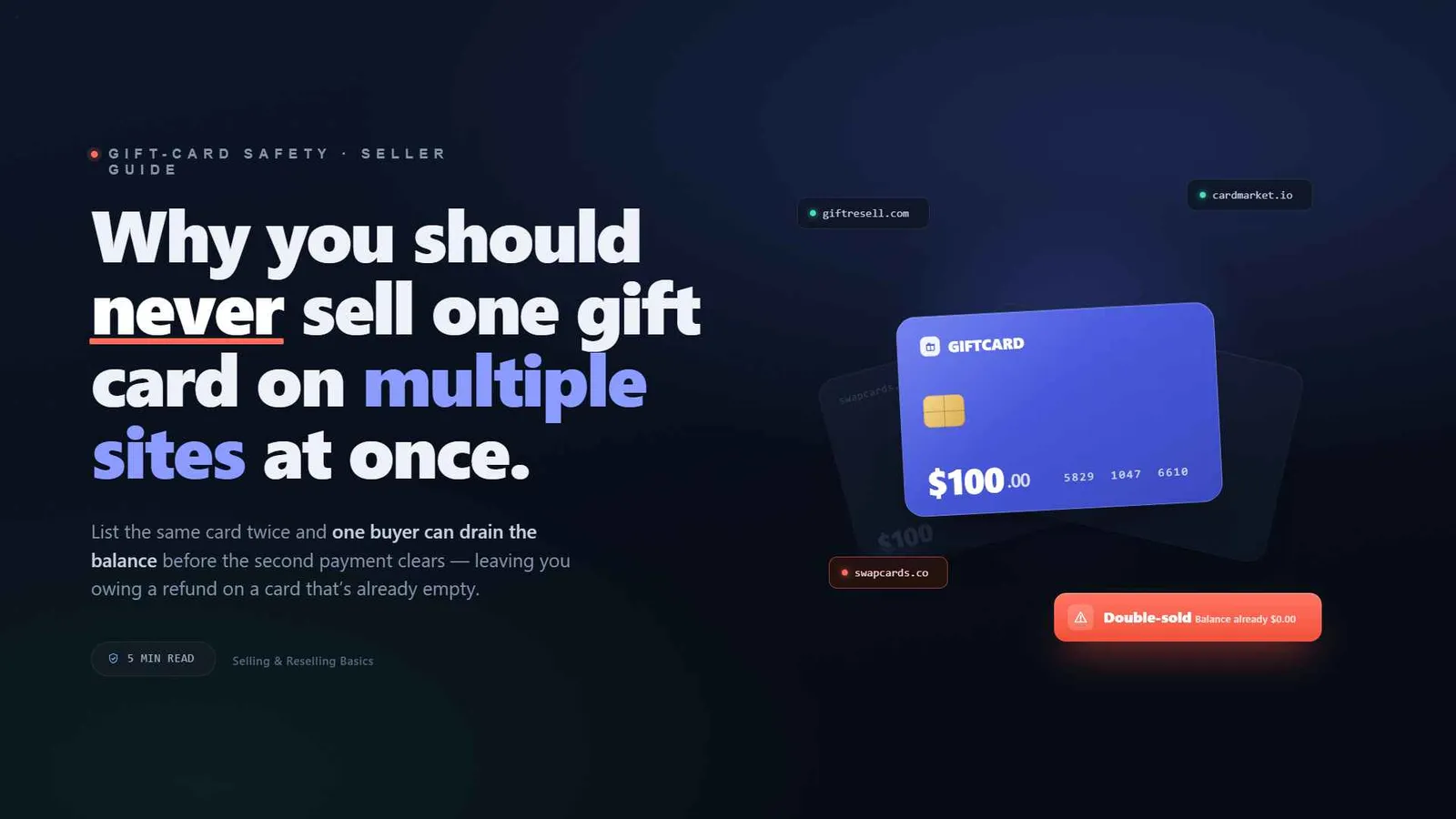
The Hidden Risk of "Shopping Around" When You Sell a Gift Card
You've got a gift card you're never going to use. Maybe it's for a store three states away, maybe it's a brand you don't shop, maybe you'd just rather have the cash. Either way, the goal is simple: turn that card into money, fast.
So you do what anyone would do. You type "sell gift card for cash" into Google, a wall of results comes back, and you start working through them. One site quotes 82% of face value. Another says 85%. A third promises instant PayPal. To save time, you figure you'll hedge your bets and punch the same card number and PIN into a few of them, then go with whoever pays first or pays most.
That instinct feels smart. It's actually one of the fastest ways to lose the whole balance.
A gift card number is just cash with extra steps
Here's the part people forget. When you hand over a gift card's number and PIN, you're not handing over a claim ticket that only works for you. You're handing over the money itself. Whoever holds that combination can spend it, online, at checkout, anywhere the card is accepted. There's no name attached, no password, no second factor. The code is the value.
That changes who you should trust with it. A debit card has your bank's fraud team standing behind it. A gift card has nothing. Once the code leaves your hands, the protection leaves with it.
The buyback space is full of people who won't pay you
Legitimate gift card buyers do exist. But the low barrier to spinning up a slick-looking "we buy gift cards" website means the space is also crowded with operators who have no intention of sending you a dime. The playbook is boring and effective: collect your card details, drain the balance, then either ghost you or stall with "processing delays" until you give up.
When you submit one card to five sites, you're not collecting five competing offers. You're broadcasting one live, spendable code to five strangers. You only need a single one of them to be dishonest for the money to be gone.
And if it's gone, you'll never prove who did it
This is the trap that turns a bad idea into an unfixable one.
Say the balance gets zeroed out an hour after you submitted it. You go to complain. The first question anyone asks, whether it's the card issuer, your payment app, or the buyback site, is "who did you give the code to?" And your honest answer is "five different companies."
At that point, nobody can untangle it. The card's transaction history shows the balance was redeemed; it does not show which of the five parties typed the code in. Each service shrugs and says it must have been one of the others. The issuer points out that gift cards aren't covered the way credit cards are, and closes the case. You're left with nothing, no way to assign blame, and no one obligated to make you whole.
Give the code to one company and you at least have a single party to hold accountable. Give it to five and you've built your own dead end.
A cleaner option: trade the card instead of cashing it out
Step back and ask what you actually want here. In most cases it isn't literally cash. It's the freedom to put that value toward something you'd really buy. If that's the real goal, selling the card for a discounted payout is the long way around, and it drops you straight into the riskiest corner of the market.
Swapping is the smarter route. Instead of converting a card you won't use into cash (minus a cut, minus the fraud exposure), you trade it for a card you will use. A service like flip.gift is built around exactly that idea: bring the gift card you're stuck with, walk away with one you actually want. You skip the buyback gauntlet entirely, and you're dealing with a single platform instead of scattering your card details across the open web.
If you do sell, follow one rule
Sometimes you genuinely need the cash, and that's fine. Just don't let the urgency talk you into the multi-site approach. Pick one service. Vet it the way you'd vet anyone you were about to mail money to: look for a real company behind it, a track record, reviews that read like actual humans wrote them, clear payout terms. Submit the card there and nowhere else. Wait for that transaction to fully resolve before you even think about trying another.
One card, one recipient. That single habit strips out almost all of the danger, because it keeps your code out of unknown hands and leaves you with a clear answer to the only question that matters when something goes wrong: who had it.
The few minutes you'd save by blasting your card across half a dozen sites are not worth the balance you're risking. Slow down, pick one trusted destination, and when you can, trade the card instead of selling it.